24/7 Emergency Flood Damage Restoration in Abilene
24/7 emergency flood damage restoration in Abilene and surrounding areas. IICRC-certified, insurance billing accepted. Call (325) 339-8723.
Flood damage in Abilene? We answer 24/7, and the first hours after floodwater enters a home determine how much of the structure can be saved versus torn out. Flash flooding here moves fast: Abilene’s clay and caliche soils shed rain instead of absorbing it, so a heavy storm can push water from Cedar Creek, Elm Creek, or an overwhelmed street drain into a house within minutes, carrying silt, lawn chemicals, and sewage-adjacent runoff with it. That’s a different problem than a burst pipe, and it has to be treated that way from the first walkthrough.
What flood damage restoration actually involves
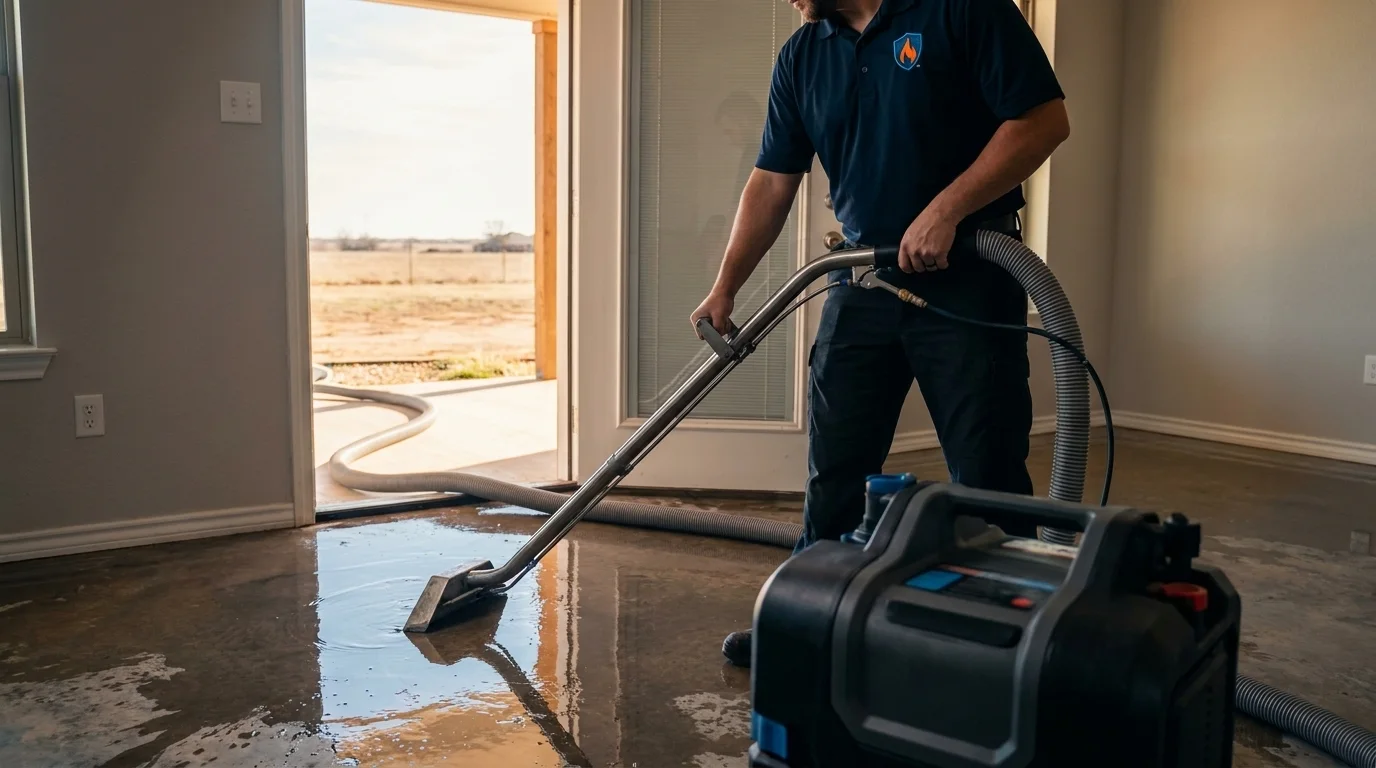
Floodwater is almost always classified as Category 3, grossly contaminated water, regardless of whether it looks “just muddy.” That classification drives the whole job. Crews extract standing water with truck-mounted or portable pumps, remove silt and debris that settles into flooring and wall cavities, and pull out porous materials, carpet pad, baseboards, insulation, sometimes drywall, that can’t be sanitized and dried in place. What’s left gets treated with an EPA-registered antimicrobial, then dried with air movers and dehumidifiers while moisture content is tracked in the framing and subfloor, not just the surface, until readings return to a dry standard.
Our process
- Safety and hazard check. Power is shut off to affected circuits, standing water is checked for contamination and electrical risk, and any compromised flooring or ceilings are flagged before anyone walks further into the structure.
- Extraction and debris removal. Pumps and extractors remove bulk water first, followed by manual removal of silt, mud, and debris that floodwater deposits in corners, under cabinetry, and inside wall cavities.
- Flood cut and selective demolition. Drywall and insulation are cut out above the waterline, typically 12 to 18 inches, because wet insulation wicks moisture upward long after the visible water line looks dry.
- Antimicrobial treatment. Affected framing, subfloor, and remaining porous surfaces are treated to address the bacterial and organic load that Category 3 water leaves behind.
- Structural drying with monitoring. Air movers, dehumidifiers, and daily moisture readings run until framing and subfloor moisture content returns to a dry standard, with documentation at each check.
What separates a good flood response from a bad one
The most common mistake is treating a flood like a clean-water leak: drying in place instead of removing what’s actually contaminated. Carpet and pad that sat in floodwater, even for a few hours, generally can’t be salvaged safely, and insulation behind a flood-cut line has to come out, not just dry out, because fiberglass and cellulose hold contaminated moisture against the framing. Adjusters look for documented moisture readings at the start and end of drying, photos of the flood-cut height and reasoning, and a clear category and class designation on the scope, not just a verbal “it’s dry now.” Skipping disposal manifests for removed porous materials, or drying a room without checking the wall cavity behind it, is how mold complaints show up six weeks later.
What does flood damage restoration cost?
Costs depend on how much water intruded, how long it sat, and how much demolition the contamination level requires. These are typical industry ranges, not a quote: every flood loss gets a written scope from Air Care Restoration before any work starts, so you know what’s included and what isn’t.
| Scenario | Typical range |
|---|---|
| Single room, minor water intrusion | $1,500 - $4,000 |
| Whole-floor flooding, contaminated water | $5,000 - $12,000 |
| Flood cut with drywall and insulation removal | $8,000 - $20,000 |
| Basement or crawlspace flood with silt and debris | $4,000 - $10,000 |
| Large residential loss requiring reconstruction | $20,000 and up |
Standard homeowners insurance typically excludes damage from rising floodwater, storm surge, or overland flooding; coverage for that usually comes from a separate flood policy such as NFIP. Water damage from a covered peril, like a storm-driven roof leak, is handled differently, and we document the loss clearly so your claim is routed correctly regardless of which policy applies.
Seasonal & regional considerations
Abilene’s flood risk clusters around spring and early summer storms, when several inches of rain can fall faster than the ground can take it. Because the soil here is dense clay and caliche rather than sandy loam, runoff concentrates quickly in low-lying yards, older neighborhoods with undersized drainage, and homes near Cedar Creek or Elm Creek. A dry spell followed by a sudden downpour is often when basements, crawlspaces, and slab homes with low entry points take on water with little warning.
Service area
Air Care Restoration responds to flood damage throughout Abilene and the surrounding communities, including Clyde, Tuscola, Buffalo Gap, Merkel, and Impact.
If water has already come into your home, don’t wait to see how it dries on its own. Call (325) 339-8723 to schedule your flood damage assessment and get a written scope before more of the structure is affected.
Services We Handle
- Flood Restoration
Frequently Asked Questions
Does homeowners insurance cover flood damage restoration?
Why does floodwater get removed instead of just dried?
What is a flood cut, and why does it go so high above the water line?
How long does flood damage restoration typically take?
What should I do while waiting for a flood damage crew to arrive?
Looking for the best flood damage restoration company in Abilene?
Air Care Restoration provides licensed and insured flood damage restoration in Abilene, TX and the surrounding area, and has served local property owners since 2026. Customers rate us 5.0 out of 5 stars across 22 Google reviews. We answer calls 24/7 — call (325) 339-8723 for immediate help.
Need Flood Damage Restoration now?
We respond 24/7 across Abilene and surrounding TX cities.
Related Coverage
- Our Restoration Services
- Contact Air Care Restoration
- Restoration Services in Albany
- 24/7 Emergency Flood Damage Restoration in Anson
- Restoration Services in Baird
- Restoration Services in Ballinger
- Restoration Services in Bronte
- 24/7 Emergency Flood Damage Restoration in Brownwood
- Restoration Services in Buffalo Gap
- 24/7 Emergency Flood Damage Restoration in Clyde
- Restoration Services in Coleman
- Restoration Services in Colorado City
- Restoration Services in Comanche
- Restoration Services in Early