Large Loss and Catastrophic Response in Abilene
24/7 large loss and catastrophic response in Abilene and surrounding areas. IICRC-certified, insurance billing accepted. Call (325) 339-8723.
When a water main lets go on the third floor of an occupied apartment complex, or a fire moves through a shared attic space and touches every unit under one roof, the loss stops being a single-family repair and becomes a coordination problem. Multiple units, multiple tenants, multiple insurance stakeholders, and a building that may need to stay partially occupied while work happens around it. Large loss and catastrophic response is a different scale of job: more equipment, more crew, more documentation, and a different kind of adjuster relationship than a standard residential claim.
What large loss and catastrophic response actually involves
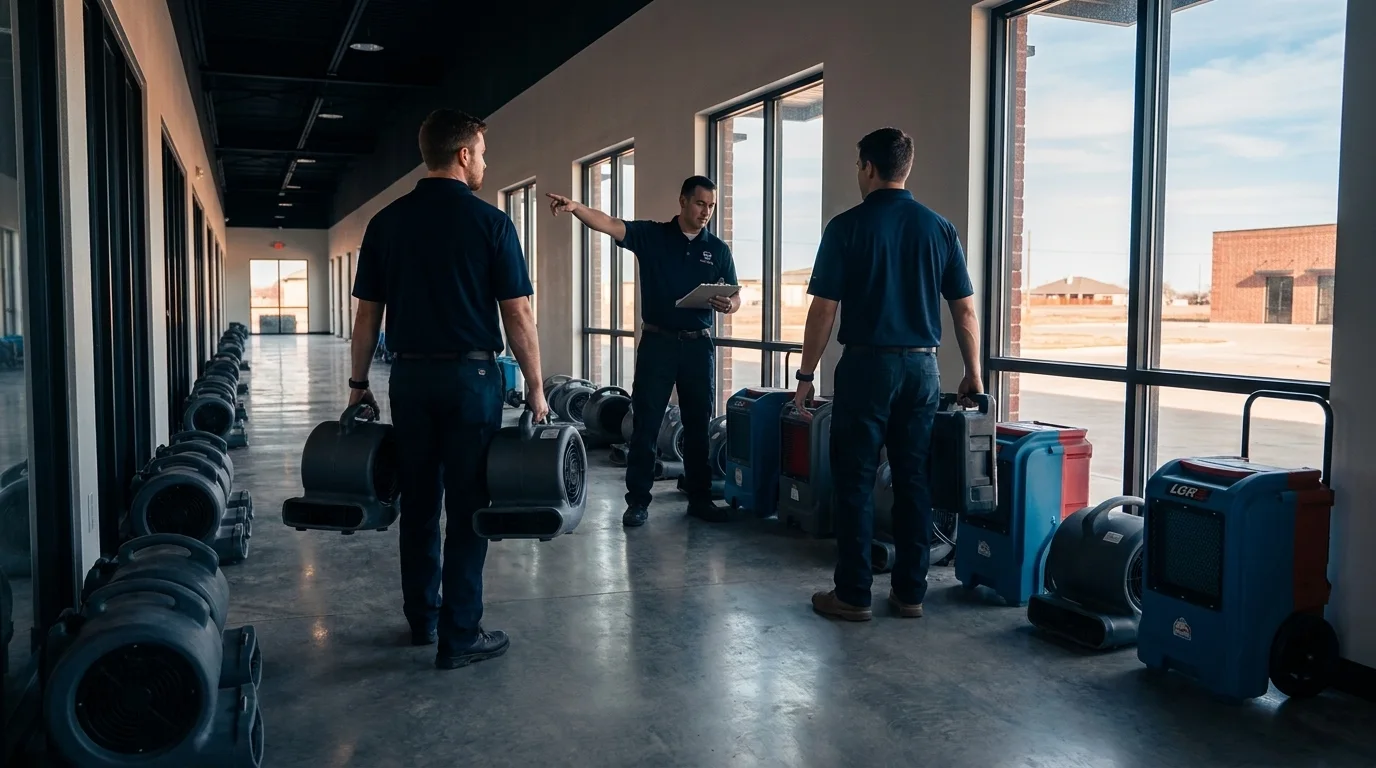
A large loss is generally defined by scope and dollar value rather than by damage type: a multi-building apartment complex hit by the same storm, a commercial property with water or fire damage across several floors, a mixed-use building where residential and retail tenants are both displaced. These jobs typically involve a general contractor or property management group, a dedicated large loss adjuster (a different role than the desk adjuster on a homeowner claim), and sometimes an engineer or structural consultant depending on what the building sustained. Work is almost always phased, meaning drying and demolition happen in one section while occupied or undamaged units continue operating nearby. Equipment volume scales accordingly: dozens of air movers and multiple commercial dehumidifiers running simultaneously across a building rather than a handful in a single home.
Our process
- Rapid crew and equipment mobilization. Catastrophic losses need resources deployed at the scale of the damage, not the scale of a typical residential call. That means pulling in additional trucks, drying equipment, and trained technicians from the outset rather than scaling up as the job reveals itself.
- Building-wide moisture and damage mapping. Before any drying or demolition starts, every affected unit or floor gets documented individually, moisture readings, photos, and a damage log, because a multi-unit claim lives or dies on how well the scope is recorded from day one.
- Coordination with the large loss adjuster and property management. These claims move through a different track than standard homeowner claims. We work directly with the adjuster’s scope, the property manager’s timeline, and often a general contractor’s schedule so the numbers and the work stay aligned.
- Phased drying, demolition, and reconstruction. Sections of the property are worked in a sequence that limits how long tenants or business operations are displaced, with clear handoff points between mitigation and rebuild.
- Consolidated documentation for the claim file. Multi-million dollar claims get audited closely. Every unit’s readings, materials removed, and equipment run-time are logged so the final invoice matches the physical work performed.
What separates a good large loss response from a bad one
The most common failure on catastrophic jobs is under-resourcing: a crew sized for a single house shows up to a forty-unit complex and spends the first week playing catch-up while materials that should have been pulled on day one keep absorbing moisture. Cross-contamination between units is another recurring problem, water or soot moving through shared wall cavities or HVAC returns that nobody mapped before starting demolition. Adjusters on large losses are looking for unit-by-unit documentation, not a single blanket estimate for the whole property; a scope that lumps everything together tends to get pushed back and delays payment. Good operators also plan the phasing around occupancy, keeping livable units livable and giving property managers a realistic timeline instead of an optimistic one that slips week after week.
What does large loss and catastrophic response cost?
Catastrophic losses vary enormously depending on the number of units affected, the category of water or type of fire damage, and whether structural or reconstruction work is involved, so the ranges below are typical industry figures for planning purposes only, not a quote. Every large loss gets a written scope of work before mitigation begins, built from unit-by-unit documentation rather than a flat estimate. Commercial and multi-family property insurance typically covers sudden and accidental losses like burst pipes, fire, and storm damage, though business interruption and code-upgrade coverage vary by policy.
| Scenario | Typical range |
|---|---|
| Water loss, single floor, small commercial building | $25,000 - $75,000 |
| Multi-unit apartment water loss (5-15 units) | $75,000 - $300,000 |
| Commercial fire loss with structural damage | $150,000 - $750,000 |
| Large apartment complex, storm-related multi-building loss | $500,000 - $2,000,000+ |
| Mixed-use building, fire and water combined | $250,000 - $1,000,000 |
Seasonal & regional considerations
West Texas weather produces catastrophic losses on a wider footprint than most people expect. A single hailstorm or straight-line wind event can damage roofing across an entire apartment complex or a strip of commercial buildings in one pass, and a hard freeze can split supply lines in multiple units of the same property overnight. These multi-property events are exactly when large loss coordination matters most, because several structures need mitigation started at the same time rather than one at a time.
Service area
Air Care Restoration handles large loss and catastrophic response for commercial properties, multi-family housing, and mixed-use buildings throughout Abilene and the surrounding communities, including Abilene ISD-area properties, Sweetwater, Anson, and Baird. Response is available 24/7 for property managers, general contractors, and large loss adjusters who need a crew mobilized quickly across multiple units or buildings.
If you’re managing a property with damage across multiple units, floors, or buildings, request a large loss assessment and get a scoped, documented response mobilized before the damage spreads further through the structure.
Frequently Asked Questions
Does insurance cover large loss and catastrophic property damage?
What actually qualifies a loss as "large loss" instead of a standard claim?
How is crew size and equipment determined for a multi-building loss?
Can occupied units stay open while a large loss is being mitigated?
How is a large loss documented differently for the insurance claim file?
Looking for the best large loss and catastrophic response company in Abilene?
Air Care Restoration provides licensed and insured large loss and catastrophic response in Abilene, TX and the surrounding area, and has served local property owners since 2026. Customers rate us 5.0 out of 5 stars across 22 Google reviews. We answer calls 24/7 — call (325) 339-8723 for immediate help.
Need Large Loss and Catastrophic Response now?
We respond 24/7 across Abilene and surrounding TX cities.
Related Coverage
- Our Restoration Services
- Contact Air Care Restoration
- Restoration Services in Albany
- Restoration Services in Anson
- Restoration Services in Baird
- Restoration Services in Ballinger
- Restoration Services in Bronte
- Restoration Services in Brownwood
- Restoration Services in Buffalo Gap
- Restoration Services in Clyde
- Restoration Services in Coleman
- Restoration Services in Colorado City
- Restoration Services in Comanche
- Restoration Services in Early